Home / Blogs / Why Journaling Might Be Lying to You (And What to Do Instead)
Blogs
Why Journaling Might Be Lying to You (And What to Do Instead)
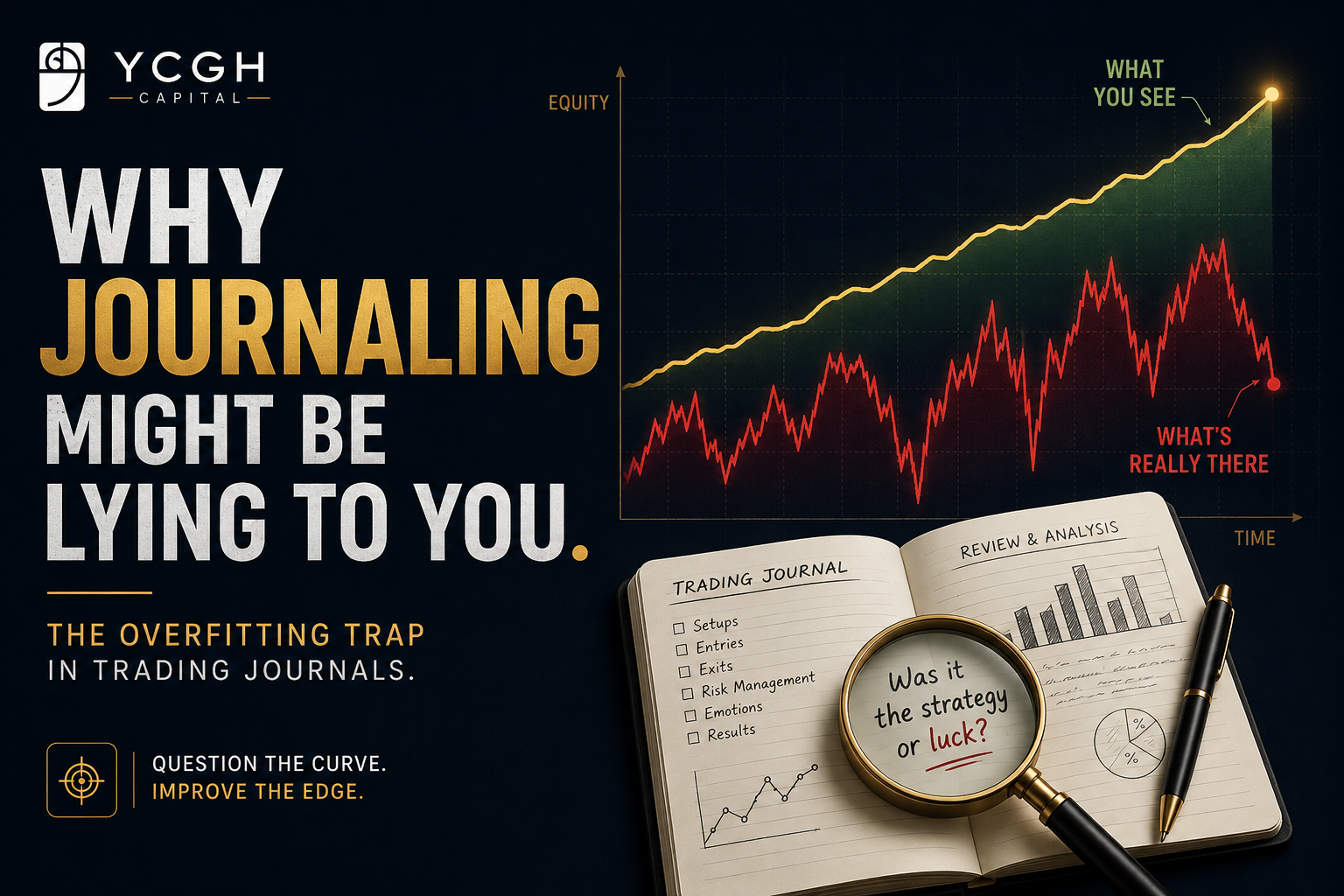
If you've spent any time in trading communities, you've heard the gospel of journaling. "Journal every trade." "Your journal is your edge." "The traders who journal are the ones who make it." It's repeated so often that questioning it feels almost heretical.
But here's an uncomfortable truth: journaling doesn't make you profitable. It makes you consistent. And consistency is only valuable if what you're being consistent about actually works.
A journal doesn't tell you if your strategy is good. It tells you what your strategy did, in the past, on the data you already have. Those are two very different things, and confusing them is one of the quietest ways traders sabotage themselves.
Let me show you how this trap works
Say you build a trading algorithm for XAUUSD, EURUSD, US500, and a few other instruments. You backtest it for a month. Solid effort, solid data.
When you dig into the results, you notice something: your shorts on XAUUSD have been dragging down your overall performance. Longs are clean. Shorts are messy.
So you make a small, "reasonable" tweak, you hardcode the system to skip shorts on XAUUSD entirely.
You rerun the backtest.
The equity curve now looks beautiful. Smoother. Higher win rate. Better drawdown profile. You did it, you fixed the system.
Except you didn't fix anything. You overfit it.
## What actually happened
That one month of data contained a specific sequence of price action, a specific set of conditions under which XAUUSD shorts happened to lose. By removing shorts, you didn't remove a flaw in your logic. You removed the exact trades that were unprofitable in that particular window of history.
Nothing tells you that gold won't trend downward hard next quarter, handing your (now short-less) system a string of missed profits and left-on-the-table gains, or worse, that removing shorts quietly changes the character of the whole portfolio in ways you haven't tested for.
The equity curve looks amazing because you shaped it to look amazing, after the fact, using knowledge you only had because the past already happened. That's the core of overfitting: your system starts memorizing the exam instead of learning the subject.
##And here's where journaling actually makes it worse
Now imagine you journal this decision.
You write it up neatly: "Noticed shorts underperforming on XAUUSD. Removed them. Equity curve improved significantly. Good adjustment."
It reads like a disciplined, data-driven trader making a smart refinement. It feels like progress. Your journal now has a clean narrative, a "lesson learned," a chart that goes up and to the right.
But the journal isn't validating your edge. It's validating your narrative about your edge, and narratives are incredibly easy to make convincing after the fact. You didn't test whether removing XAUUSD shorts is a good rule. You tested whether removing them made last month look better. Then you wrote it down as if it were wisdom.
This is the trap: a journal is only as honest as the process feeding it. If the process is flawed, curve-fit, data-mined, adjusted in hindsight, the journal doesn't catch that. It just archives it in a format that feels credible. You end up with a beautifully organized record of decisions that were never actually tested against anything except the past.
##So is journaling useless?
No, but it's not the magic discipline tool it's marketed as. Journaling records what happened. It does nothing on its own to tell you why it happened, or whether it will keep happening. Without a rigorous process behind it, a journal is just a diary with better formatting, and diaries are very good at making bad decisions sound like insight.
The real question isn't "did I journal this trade/decision?" It's "did I test this decision the right way before I let it into my system, and did I journal the process, not just the outcome?"
##A better way to journal
If you want your journal to actually protect you instead of flattering you, shift what it captures:
1. Journal the hypothesis before the result. Before you make a change, like removing XAUUSD shorts, write down why you think it's true, and what would prove you wrong. "I believe shorts underperform because of X macro condition, not just because of this month's data." If you can't articulate a reason beyond "the equity curve says so," that's a red flag worth recording.
2. Journal out-of-sample, not just in-sample. Don't just log what worked on the data you tuned against. Log how the change performs on data it has never seen, a different time period, a different regime. If your journal only ever contains backtest confirmations, it's an echo chamber.
3. Journal the number of adjustments, not just the adjustments. Every time you tweak a rule to fit the data better, write it down as a tally. If you've made 15 "small reasonable adjustments" to fit one month of price action, your journal should be screaming "overfitting risk," not celebrating a smoother curve.
4. Journal your emotional state, separately from your logic. Genuinely useful. Did you feel FOMO? Fear? Overconfidence after a win streak? This is where journaling earns its reputation, tracking your psychology is something a backtest can't do for you.
5. Journal disconfirming evidence on purpose. Actively look for trades or data points that argue against your favorite rule, and log them too. If your journal only contains evidence supporting your decisions, you're not journaling, you're building a defense brief for yourself.
### The takeaway
A journal is a mirror, not a filter. It reflects whatever you feed it, good process or bad, honest testing or hindsight bias. The danger isn't journaling itself. It's mistaking a well-kept record of flawed decisions for validation of those decisions.
Before you trust your journal, trust your process. Test on out-of-sample data. Be suspicious of any equity curve that got prettier the moment you started editing it after seeing the result. And when you do journal, journal the reasoning and the doubts, not just the wins.
Because a beautiful equity curve built on hindsight isn't an edge. It's a story you told yourself, written down neatly enough to believe it.