Home / Blogs / Position Sizing Is the Only Edge Most Traders Actually Have
Blogs
Position Sizing Is the Only Edge Most Traders Actually Have
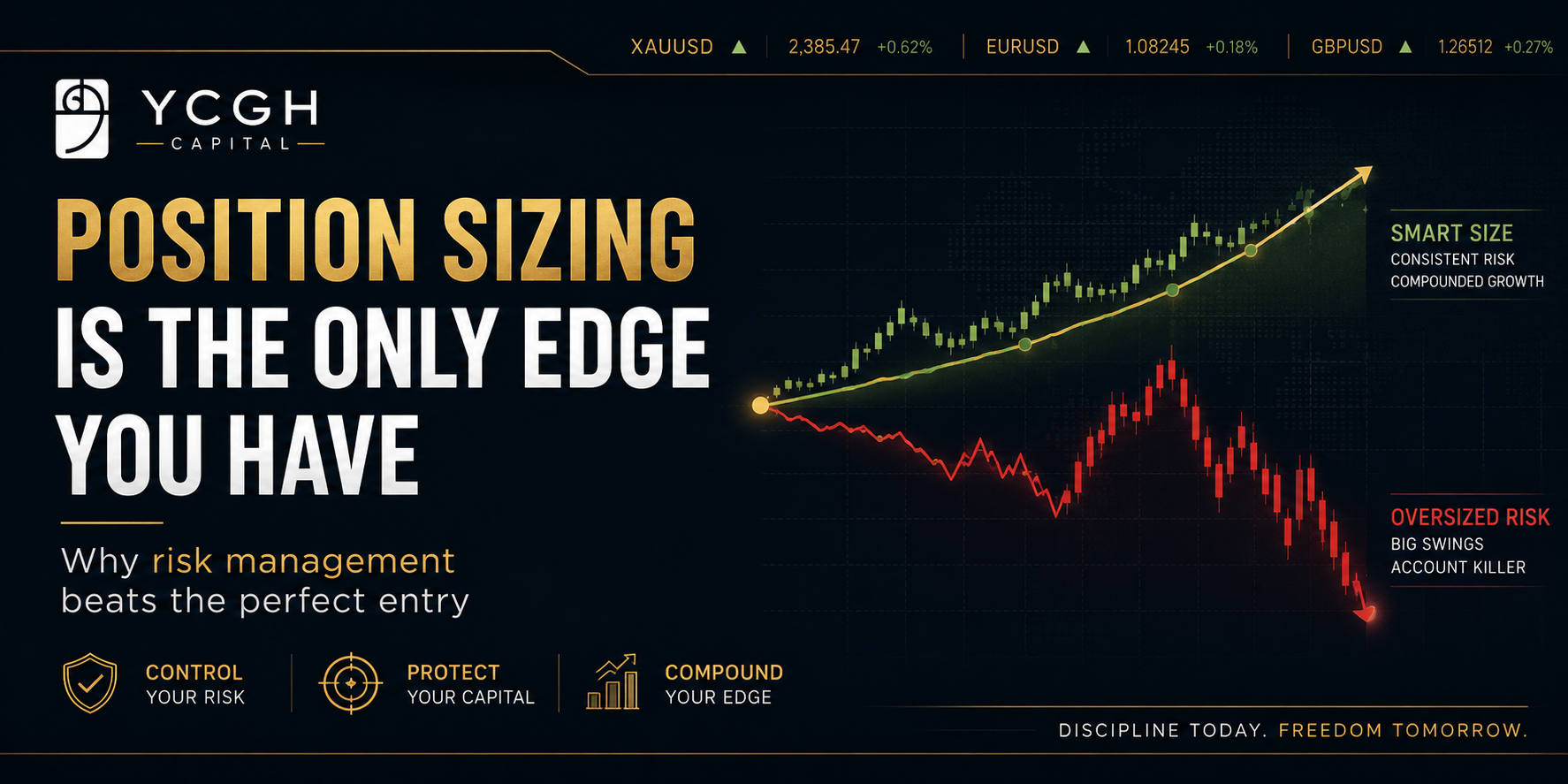
Walk into any trading forum, Telegram group, or YouTube comment section, and you will find the same obsession repeated a thousand different ways. Someone is hunting for the perfect entry. The perfect indicator. The perfect confirmation candle that will finally separate a losing trader from a winning one. Meanwhile, the question that actually determines survival, how much to risk on any single trade, gets treated as an afterthought, something to figure out "later" once the strategy is "sorted."
This is backwards. And it is the single most common reason traders with genuinely decent strategies still end up staring at a margin call.
Here is the uncomfortable truth this blog is built around, how much you risk matters more than when you enter. Most blown accounts are not the result of bad analysis. They are the result of good analysis paired with reckless sizing. You can be right more often than you are wrong and still go broke, if you size your trades like you are trying to get rich in a week instead of stay in the game for a decade.
Two Traders, One Strategy, Two Very Different Outcomes
Let us make this concrete with an example on XAUUSD, since gold is volatile enough to punish careless sizing quickly.
Imagine two traders, Trader A and Trader B, using the exact same strategy. Same entries, same exits, same 55% win rate, same average risk to reward ratio of 1 to 1. On paper, they have identical "edge."
Trader A risks 1% of account equity per trade. Trader B risks 10% of account equity per trade.
Over a small sample of trades, both might look fine. But strategies do not play out over ten trades, they play out over hundreds. And within any string of 100 trades at a 55% win rate, losing streaks of 8, 10, even 12 trades in a row are statistically normal, not rare black swan events.
Let us run the numbers on a losing streak of just 8 trades.
Trader A, risking 1% per trade, loses roughly 7.7% of their account after 8 consecutive losses. Painful, but completely recoverable. A string of decent months gets them back to breakeven and beyond.
Trader B, risking 10% per trade, loses approximately 57% of their account after that same 8 trade losing streak. To get back to breakeven from a 57% drawdown, Trader B does not need a 57% gain, they need roughly a 133% gain just to recover what was lost. That is not a bad month, that is a near impossible climb.
Same strategy. Same win rate. Same market. One trader survives the inevitable losing streak, the other is functionally ruined, even though nothing about their "edge" changed. The only variable that mattered was position size.
This is the part most traders never internalize, over a long enough sequence of trades, aggressive sizing does not just increase variance, it statistically guarantees ruin. It is not a matter of if, it is a matter of when.
The Gambler's Fallacy Hiding Inside Your Position Sizing
Most traders do not blow up because they decided, in a calm and rational moment, to risk 10% on a trade. They blow up because of what happens emotionally after a loss, or after a win.
After a loss, the instinct is to "win it back." The next trade suddenly gets sized bigger, not because the setup is better, but because the ego wants revenge on the market. This is the gambler's fallacy dressed up in trading language, the belief that after a loss, a win is somehow "due." The market has no memory of your last trade. It does not owe you anything.
After a win, a different but equally dangerous version of the same fallacy appears. A trader feels invincible, convinced they have "figured it out," and starts sizing up because the last few trades felt effortless. This is how a good week turns into a catastrophic one, a trader gets loose with size right before the losing streak that markets eventually deliver to everyone.
Both patterns come from the same root problem, letting emotion, not math, decide position size. Every single trade should be sized the same disciplined way, regardless of how the last trade went. Your win rate does not change because you just lost, and it does not improve because you just won.
Why Fixed Dollar Risk Quietly Kills Shrinking Accounts
Here is a subtler trap that catches even traders who think they are being disciplined.
Say a trader decides to risk a fixed dollar amount per trade, for example $500, regardless of account size. This feels consistent on the surface, but it behaves very differently depending on account trajectory.
If the account is growing, fixed dollar risk becomes an increasingly small percentage of equity, which is actually fine, even conservative. But if the account is shrinking, that same $500 becomes an increasingly large percentage of a smaller base. A trader on a losing streak, risking a fixed dollar amount, is unknowingly increasing their percentage risk with every loss, which is the exact opposite of what should happen during a drawdown.
This is revenge sizing wearing a disguise of discipline. The trader believes they are being consistent because the dollar figure never changed, but the account cannot tell the difference between "consistent dollar risk" and "increasingly reckless percentage risk" when equity is falling.
The fix is simple, risk a fixed percentage of current equity, not a fixed dollar amount. As the account shrinks, position size shrinks with it. As the account grows, position size grows with it. This single adjustment is one of the most underrated survival mechanisms in trading.
Volatility Adjusted Sizing, Because 1% Is Not 1%
Here is a mistake that even traders who understand percentage risk still make, treating a 1% risk on XAUUSD as equivalent to a 1% risk on US500, simply because the percentage number is the same.
It is not the same. Not even close.
Gold can move 15 to 20 dollars in a matter of minutes during a news event. US500 has an entirely different volatility profile, different average true range, different typical stop distances. If a trader uses the same lot sizing logic across instruments without adjusting for volatility, they end up accidentally taking on wildly different amounts of real risk while believing they are being consistent.
Position sizing has to account for the actual volatility of the instrument being traded, not just the percentage of equity being risked. In practice, this usually means calculating position size based on the distance to your stop loss in that specific instrument's volatility terms, not using a flat lot size across everything you trade. A stop that is appropriately placed on XAUUSD might be far too tight, or far too wide, if applied with the same logic to a different instrument entirely.
Skipping this step is how traders end up with a portfolio that looks diversified on paper but is secretly concentrated in risk, because one or two volatile instruments are quietly carrying disproportionate weight in every drawdown.
Risk of Ruin, Explained Without the Math Headache
"Risk of ruin" sounds like an academic concept, but it is one of the most practically useful ideas in trading, and it is not complicated once you strip away the formulas.
Risk of ruin is simply the probability that a string of losses, given your win rate and your position size, will wipe out your account before your edge has a chance to play out over the long run.
Here is the intuitive version, a strategy with a 55% win rate is profitable over time, but "over time" requires surviving the losing streaks that happen along the way. A few oversized losses in a row, especially if position size increases during that streak due to revenge trading, can end an account that had a completely valid, profitable strategy behind it.
The strategy was never the problem. The account did not have enough runway to let the edge play out, because sizing decisions consumed that runway too quickly.
This is why professional risk management always circles back to the same principle, your job is not to maximize the result of any single trade, your job is to make sure no single trade, or short sequence of trades, can end your ability to keep trading. Survival is what allows a small statistical edge to eventually show up in your equity curve. Without survival, the edge never gets the chance to prove itself.
The Takeaway
An average strategy with excellent sizing will, almost every time, outperform an excellent strategy with average sizing.
This is not a motivational quote, it is closer to a law of trading physics. A mediocre strategy that consistently risks 0.5% to 1% per trade, adjusted for volatility, sized as a percentage of current equity, and never influenced by the emotional aftermath of the last trade, will still be standing after a hundred trades, a thousand trades, several years. A brilliant strategy paired with 10% risk per trade is a countdown clock to a blown account, no matter how good the entries are.
Entries get all the attention because they feel like the exciting part of trading, the skill, the analysis, the "edge." But position sizing is the quiet, unglamorous discipline that actually determines whether a trader gets to keep playing the game long enough for that edge to matter.
If there is only one thing to fix in your trading this year, fix your sizing before you touch your strategy. Everything else is downstream of whether you are still in the game.
This article is for educational purposes only and does not constitute financial advice. Trading forex, gold, and indices carries substantial risk of loss and is not suitable for all investors.